April 2026 Update
April 2026 update
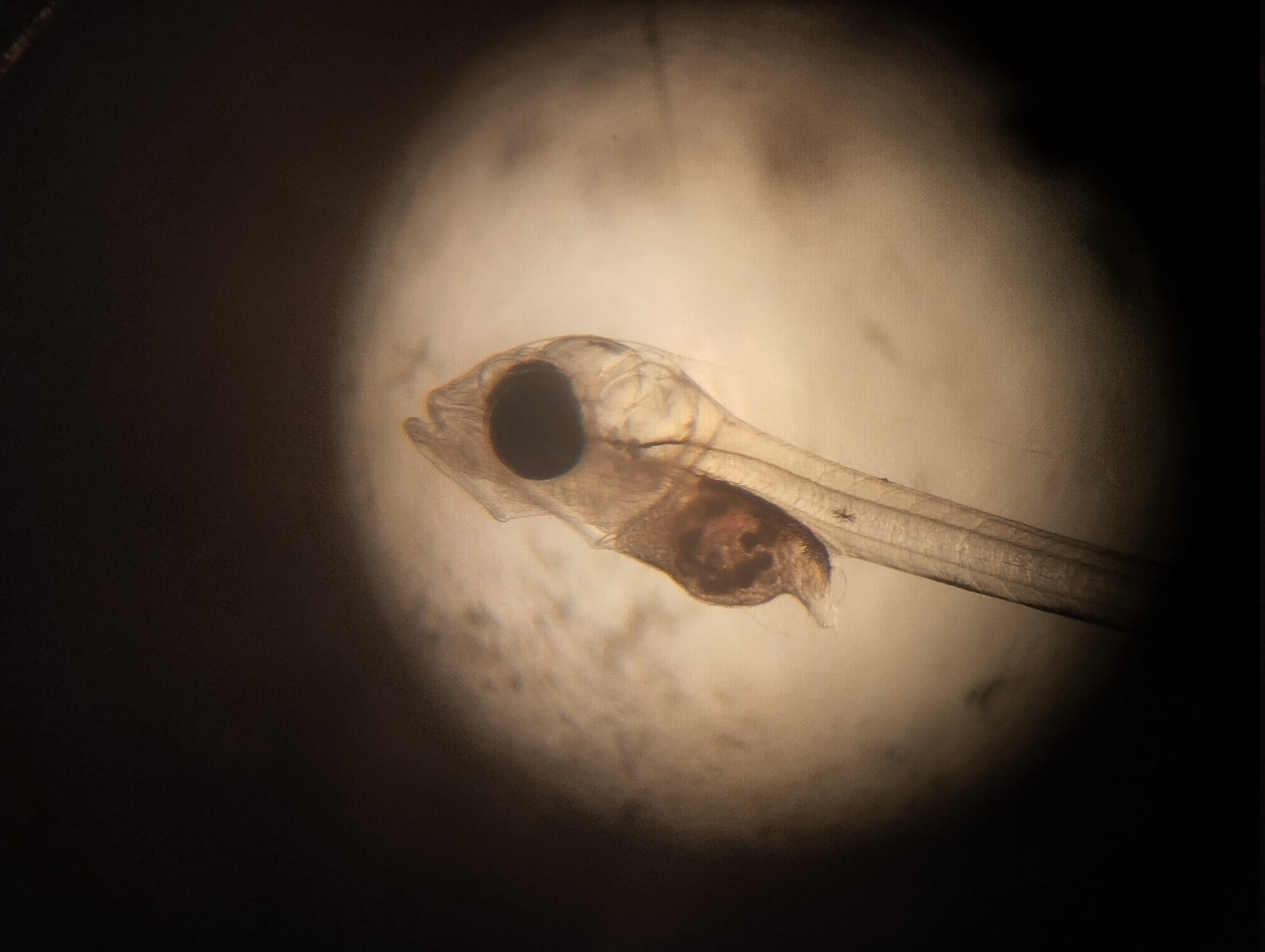
Earlier in Q1 2026, we ran a new set of trials at CTAQUA (Spain) to evaluate the latest AquaSnow formulation in gilthead seabream (Sparus aurata) larvae. After a few weeks of data collection and analysis, we now have a clearer picture of where things stand.
This was a 28-day trial covering the full early larval phase, from first feeding (around 3–5 days post-hatch) through to the start of weaning (~30 dph). The goal was to assess an updated AquaSnow formulation (more dense with higher dry matter content) could support early-stage feeding compared to standard live feed protocols.
The headline result
The updated formulation did not perform as expected in terms of survival and growth.
During the trial, divided in three phases (early, mid, weaning), larvae fed live feed maintained survival around ~48%, while the AquaSnow groups dropped below 2%
Larvae on live feed also reached larger sizes than those fed the microdiet.
So at a high level: our new formulation, designed to be more nutrient-dense and with higher dry matter content, had poor digestibility compared to our previous formulation.
Feeding acceptance is excellent
The important detail is that acceptance, which often is the first bottleneck, is solved for seabream, too. Across all stages of the trial, larvae detected the particles immediately and ingested them without hesitation.
We now know that seabass and seabream can be fed AquaSnow without issues - the work ahead remains to ensure digestibility and nutrition.
Solid progress on the operational side
On the practical side, the trial was productive.
We refined feeding protocols, including:
-
Dosing strategies, including successful automatic feeding with peristaltic pumps.
-
Feeding frequency (up to 12 times/day in later stages) to flatten organic load through the day.
-
Handling and storage.
We also validated a particle size range (particularly 50–125 µm) that works well across the larval phase. These particles stayed suspended longer, improved interaction with larvae, and reduced tank fouling compared to larger fractions.
From a hatchery perspective, the product is easy to work with:
-
No issues with storage or handling
-
Clean application during feeding
-
No measurable negative impact on water quality or bacterial load
The weaning challenge
In the final phase, we tested direct transitions to inert diets. Interestingly, the co-feeding group (AquaSnow + inert diet) showed better feed intake and growth compared to inert diet-only groups. This suggests there’s a viable pathway where AquaSnow can facilitate the weaning process. More research is needed in this part.
The next steps
Back at the office, we’re already working on the next iteration.
The focus is on improving digestibility and nutrient release, building on the validated particle size range. We’re also upgrading equipment and continuing work on permitting ahead of the next round of trials.
Final thought
This trial didn’t deliver the results we’re aiming for, but it confirmed us how formulation changes affect digestibility negativel, which is a new development. The trial also helped us to iron out the details on how to store, dose and control AquaSnow during the production process, and gives us the confidence to produce better protocols towards the launch of the product.
Other news
We have been awarded a Transnational Acccess grant under the AquaServe project to conduct trials at the Norwegian University of Science and Technology (NTNU) this summer. We will be testing AquaSnow in cod larvae through a whole larval cycle.
We have some ongoing tests carried out with yellowtail amberjack and ballan wrasse larvae. We will provide updates later.