Aquaculture Europe 2025: more options than ever in Larval Nutrition
Aquaculture Europe 2025 in Valencia hosted four dense days of talks, debate, and product presentations this September, and it felt like a small but significant checkpoint for the whole hatchery world. For anyone working in marine larvae production, it was a good place to be.
A Sector Still Building on Live Feed
The early-life session on Tuesday highlighted ongoing efforts to improve live-feed protocols.
- Rotifer enrichment and culture tweaks continue to occupy researchers and farmers alike. Decades on, we are still finding gains.
- Ready-to-hatch copepod nauplii, pioneered in Norway, always draws attention. Their nutritional quality is excellent, and the simplicity of hatching them like Artemia reduces the need for full rotifer production systems.
- Cryopreserved barnacle larvae offers a different kind of leap: a product with prey sizes spanning rotifer to Artemia, shipped frozen and revived on site.
- Micro-encapsulated dry diets capable of particle sizes matching rotifers and Artemia are edging forward, though most are still positioned as co-feeds rather than full replacements.
All but more and more options for farmers. Every incremental option strengthens the supply chain and provides farmers with backups against price and quality swings or culture crashes at the hatchery.
AquaSnow’s work on full life feed replacement
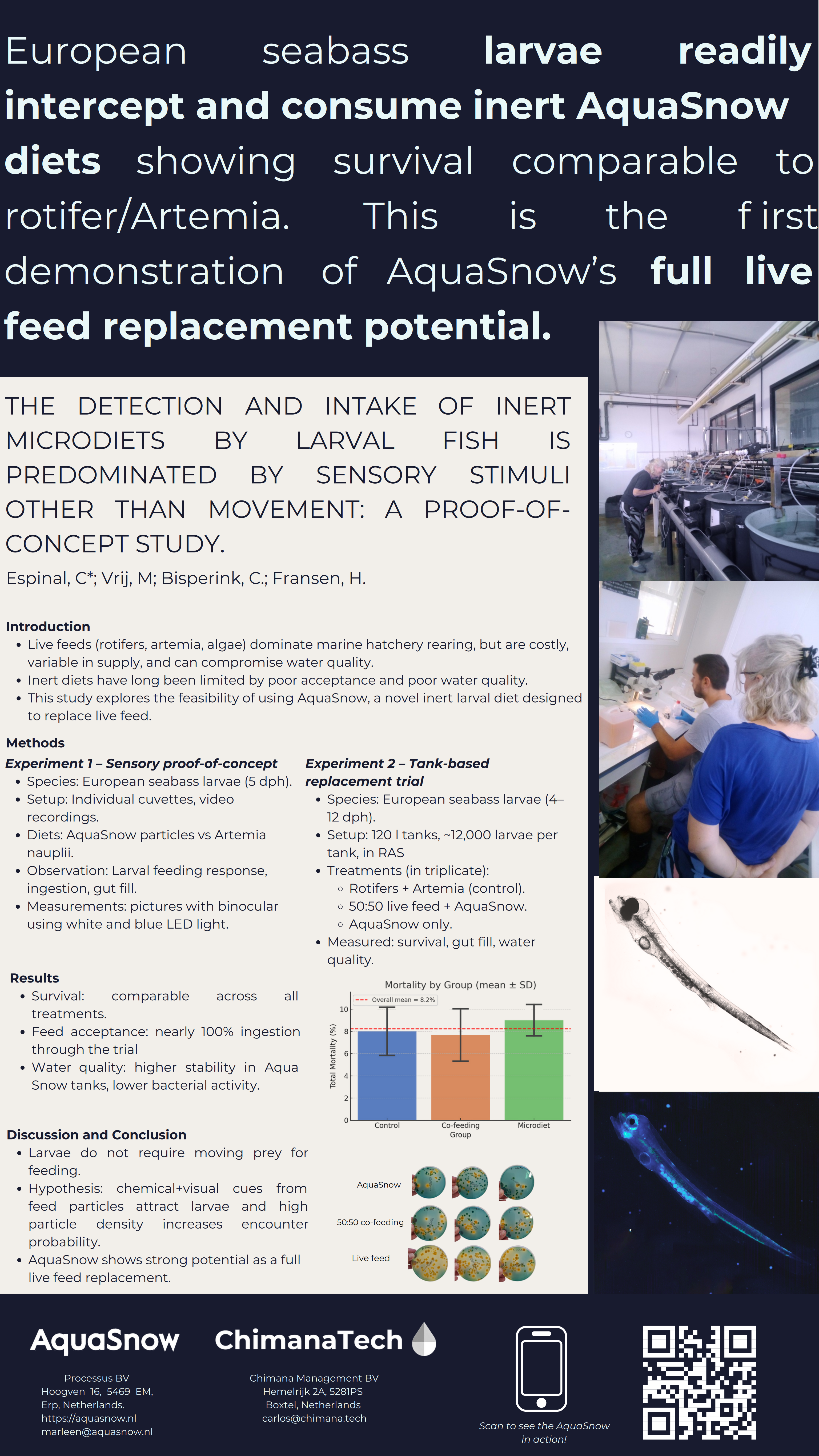
Our own contribution came in the form of a scientific poster built on two trials with European sea bass. The core question was straightforward: can AquaSnow truly replace live feeds in the critical first days after mouth opening?
Trial Design
- System: A single recirculating aquaculture system (RAS) equipped with a mechanical filter, moving-bed biofilter, protein skimmer, and circulation pumps.
- Tanks and Stocking: Nine, 120-liter tanks stocked at 100 larvae per liter.
- Treatments: Three tanks received AquaSnow as a sole diet, three followed the classical live-feed protocol (rotifers and Artemia), and three were co-fed with a 50/50 mix.
- Feeding Strategy: AquaSnow concentrations in tank water were adjusted by observing larval gut fill. Within the first three days post-mouth opening, gut fill consistently exceeded 95%, and that level was maintained throughout the trial. Feeding was done every 1-2 hours, checking for particle density in water, the same it is done with live feed.
Monitoring and Results
- Water samples were taken regularly to track overall quality and to plate for Vibrio detection.
- Mortality was recorded as the primary endpoint to verify that larvae were digesting and utilizing the diet.
After 14 days:
- Survival: No statistical differences in mortality across the three treatments.
- Water Quality: Microbial stability was highest in the AquaSnow tanks through most of the trial. Late in the period, bacterial load began to approach that of the live-feed group as overall feeding volumes increased, but levels remained well below thresholds associated with Vibrio outbreaks.
These results mark the first controlled demonstration of a shelf-stable diet sustaining marine larvae through the initial two weeks without live feeds.
Industry Context
The conference made clear that innovation is coming from every direction. Norwegian teams continue to set the pace on live-feed alternatives, southern European hatcheries are eager adopters, and equipment suppliers are refining solutions to match. It is an encouraging landscape: competitors are not obstacles but proof that demand for better larval solutions is growing.
Next Steps for AquaSnow
Our focus now is to extend trials to 30–40 days post-hatch and into additional species, then to track juvenile performance so that early nutrition translates into strong fingerlings. Nutritional fine-tuning, longer trials, and commercial validations are scheduled through 2026. Regulatory and sustainability certifications will follow so that the first market launch can target 2027.
A Direct Call to Stakeholders
We now need specific input from the people who will use or regulate this product:
- Hatchery managers — what are your biggest operational bottlenecks with live feed?
- Farmers — which performance parameters matter most before you would adopt a dry larval diet: particle stability, water quality impact, cost, or something else entirely?
- Researchers and feed developers — what additional data would you require to validate a full replacement diet in your systems?
We welcome formal trial collaborations and prototype testing under real hatchery conditions.
If you want to evaluate AquaSnow or can share precise requirements for a feed that must meet commercial standards, contact us directly. Your insight will help shape the product’s final form and its path to market!
Until the next one!