AquaSnow: lessons from a year of development
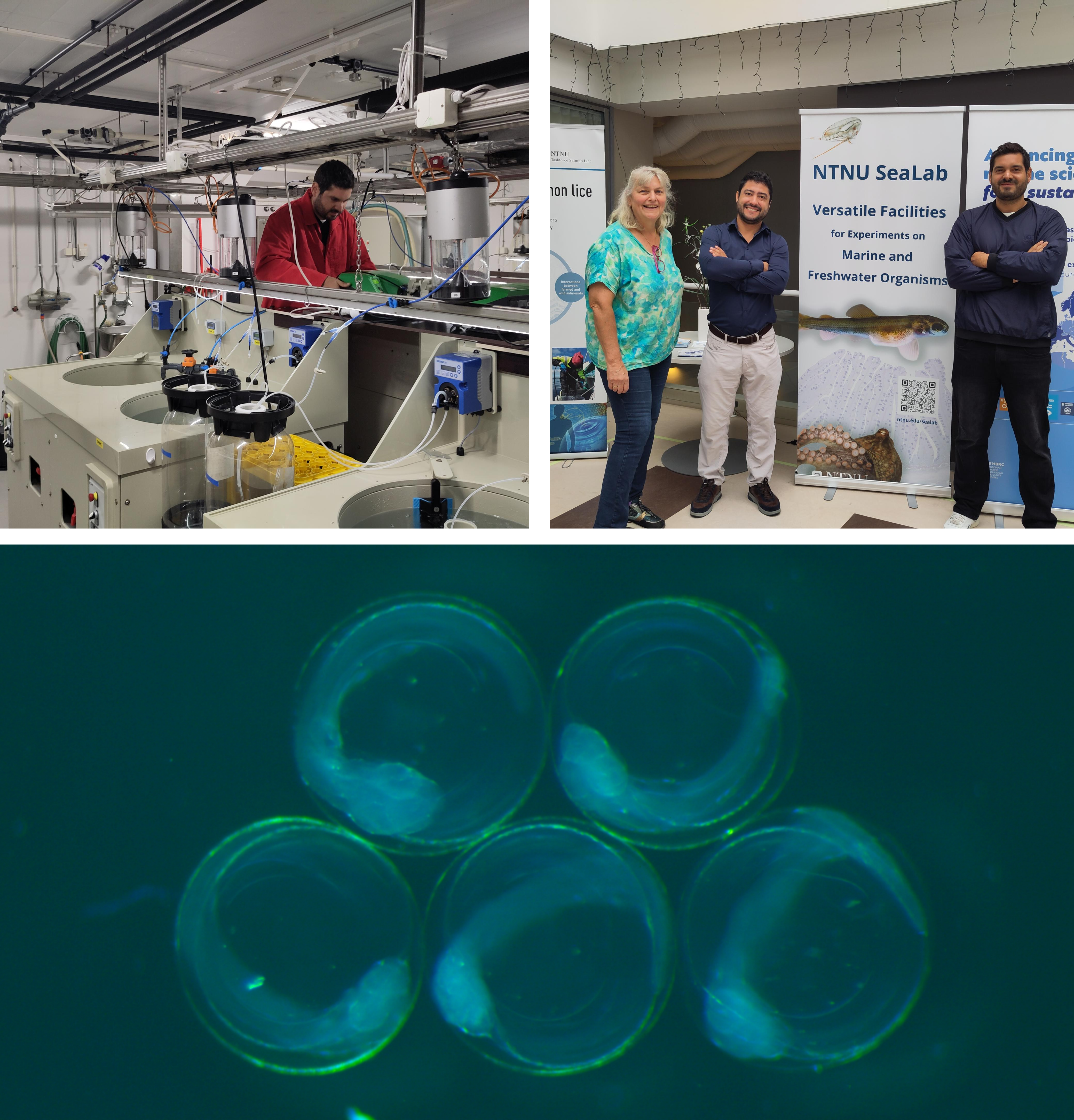
Over the past year, our AquaSnow work has covered the entire process, from manufacturing the diet to preparing it in the lab and delivering it to larvae. Four feeding studies with European sea bass, gilthead seabream, and Atlantic cod have helped us understand our manufacturing process, its limitations, and the advantages it offers. More importantly, we have iterated extensively on formulations and ingredients, trying to find the right combination that can be manufactured using EU-approved feed ingredients.
Some of the most useful progress has been in the daily work around feeding. We now have a preparation and dosing routine that is familiar to hatchery technicians, a workable method for automatic feeding, and a particle size that combines larval acceptance with prolonged suspension in the water.
The main challenge remains the diet itself. Manufacturing constraints shaped the early formulations, and a necessary change in ingredients sent us into further months of development. We have yet to reproduce the performance of our best early formulation using the feed-approved ingredients we need for the product.
That is the background to this year’s results, and it is why I remain enthusiastic about the next stage.
Manufacturing has been a central part of the work
AquaSnow is a moist microdiet being developed to replace rotifers in marine hatcheries. Its formulation has always depended on what we can manufacture into a suitable particle.
At the beginning of the project, the available machinery limited the ingredients and materials we could process. Equipment upgrades have since widened those options, allowing us to work with a broader range of ingredients and explore formulations that were previously difficult to manufacture. This has been an important development. The manufacturing process determines which ideas we can actually put into a tank and test. Improving that process has given us more room to address the nutritional limitations we are seeing.
A feeding routine that technicians already use
We have worked through the steps from receiving AquaSnow in the laboratory to preparing the daily feeding ration. That includes counting particles, adjusting the suspension to the required concentration, and preparing it for manual delivery or an automatic feeder.
We were pleased to find that this follows much the same logic as preparing rotifers: count what is available, adjust the concentration, and deliver the required quantity to each tank. Technicians can apply a workflow they already know to AquaSnow.
The same applies to checking ingestion. The routines used to assess rotifers or Artemia in larval guts also work for AquaSnow. Under the conditions we have tested, we have identified working particle concentrations at which most sampled larvae have AquaSnow in their guts. Technicians can then adjust the concentration to feed more intensively or save some feed.
Automatic feeding and particles that stay in the tank
We assessed manual feeding alongside automatic delivery using peristaltic pumps. Pump feeding proved feasible with a straightforward arrangement: a bucket or container holding AquaSnow at the required concentration, kept mixed while the pump delivers the ration over the day. Magnetic stirring is our preferred arrangement. Constant aeration can keep the particles in suspension, but it accelerates oxidation. In retrospect, given that particles can remain in suspension for hours, occasional mixing with a short pulse of air should be more than enough.
One of the most useful findings has been identifying a 60–125 µm particle fraction that works from first feeding to the onset of Artemia feeding. That particle fraction also remains in the water column for four hours or more under the conditions we have tested. This is fantastic for hatcheries: feed that settles creates cleaning work and becomes less accessible to larvae feeding in the water column. In our practical experience with this particle fraction, AquaSnow has kept tanks very clean and greatly reduced the need for continuous removal of settled feed.
These are observations from our development work. Earlier formulations and dosing approaches also produced settling or surface accumulation, but we managed to work around these issues.
The early formulation we are working to match
The summer 2025 trial was particularly encouraging. We had an ingredient combination that performed well in that early test and gave us a useful biological benchmark.
In the short sea bass trial, for example, larvae receiving AquaSnow alongside live feed reached a mean length of 5.72 mm at 12 days post-hatch, compared with 5.94 mm in the live-feed control. We found no statistically significant difference between those groups. Larvae receiving AquaSnow alone were smaller, at 5.11 mm, so there was still a growth gap to address.
An ingredient constraint then required us to change the formulation. That change has occupied subsequent months of research. We have been trying to match the performance of the early formulation while working within the ingredient options available for the intended product.
The later seabream and cod trials show the difficulty clearly. Larvae ate AquaSnow, sometimes with high gut fullness, while growth, condition, or survival remained below what we need. Some experiments were exploratory or lacked a replicated control, which limits the comparisons we can make. Ingestion has been encouraging, but adequate biological performance still needs to be demonstrated with new formulations.
Next steps
We have plenty of ideas for adjusting the formulation. Our next work will focus on whether those changes improve nutrient use and support larval development.
Digestibility and nutrient release are a priority. We want to examine how the ingredients and particle matrix make nutrients available after ingestion. We have been developing a series of in vitro methods for early assessment of digestibility, and we are now applying these alongside in vivo trials.
Microbiome modulation is another direction we want to explore. That starts with understanding the microbial communities associated with the feed, water, and larvae. Any intervention will need to show a measurable benefit against the same base formulation and rearing conditions.
Gut maturation will help us examine how the diet interacts with digestive development. Histology and digestive enzyme measurements could give us a better view of where limitations emerge. Feeding age and a defined co-feeding period also deserve further testing.
For me, the next meaningful milestone is straightforward: regain the encouraging early performance using feed-approved ingredients, then demonstrate it consistently in replicated trials and through the feeding transition. We are looking forward to that work. We have seen an early formulation perform well, expanded our manufacturing options, and made useful progress on how AquaSnow can fit into a hatchery’s daily routine. There is still a biological performance gap to close, and we now have more specific ways to investigate it. A new set of trials with new diet formulations in 2027 should bring us closer to our goal, and perhaps even achieve it.
We are in constant contact with hatcheries and suppliers, and we are always happy to showcase the product as it develops. Feel free to contact us to discuss the project!